Start with the space, not the nearest sign
Finding an open curb space is only the first step. Before parking, look at the entire stretch of curb where your car will sit. A sign may apply only in the direction shown by an arrow, between two signs, or within marked spaces. A nearby sign facing another stretch of street may not describe your spot. If the boundary is unclear, choose a less ambiguous space rather than relying on a guess.
Check the curb, pavement markings and surrounding street as well. A painted curb, loading bay marking or designated space can add information that a quick glance at a sign misses. Rules for parking near driveways, crossings, corners, bus stops and other access points vary by location; an unsigned space is not automatically unrestricted. Leave enough room to avoid blocking access, and consult local guidance when a distance or marking is uncertain.
Read every condition on the sign
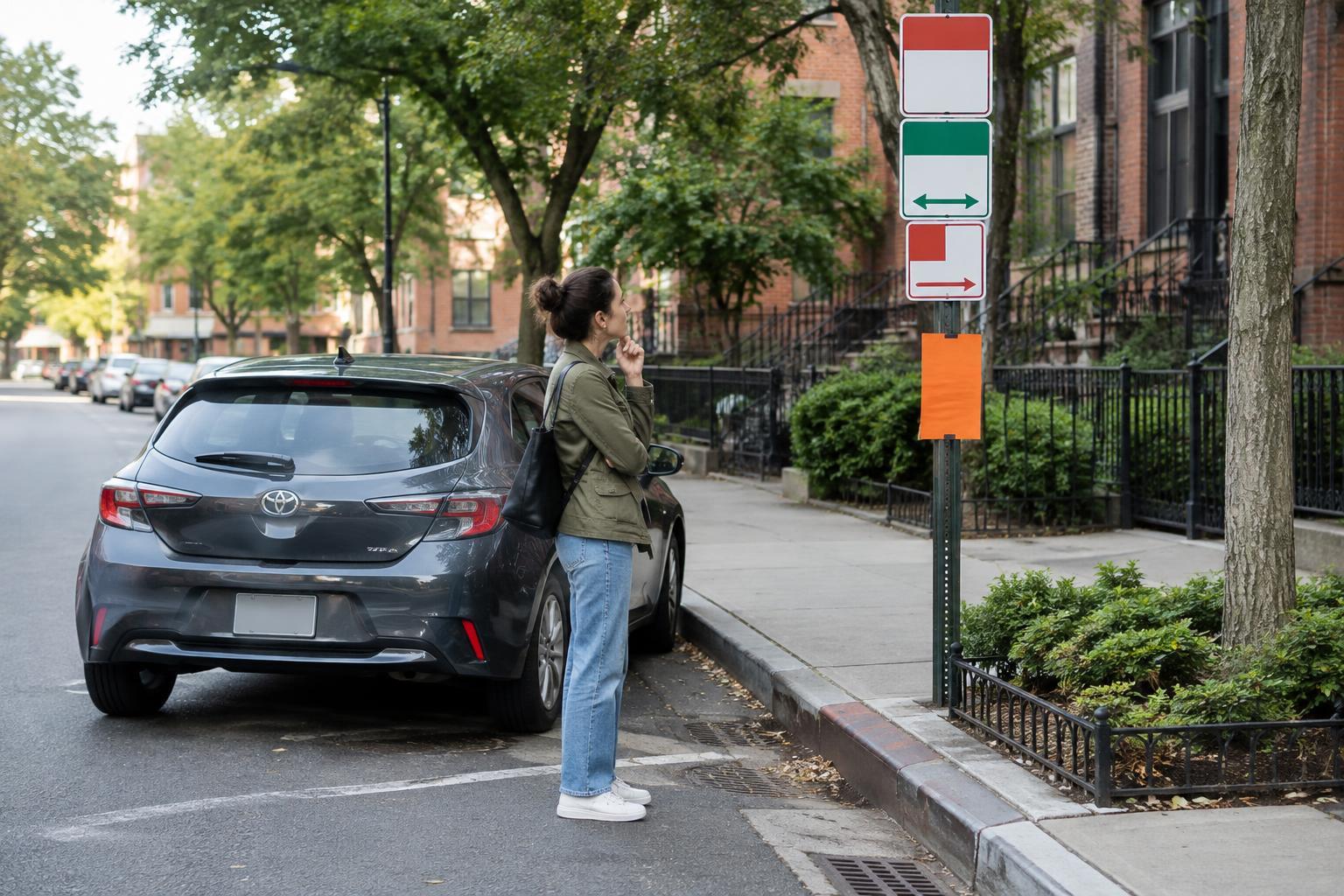
Treat a parking sign as a short set of instructions. Identify what it allows or prohibits, then look for the days, hours, time limit and any exceptions. For example, a space might allow short stays during business hours but have a different rule at night. Another might be available to permit holders during certain hours and to other drivers at different times. Read every panel attached to the post before deciding which rule applies.
Pay particular attention to words such as “except,” “only” and “during,” along with arrows pointing toward or away from your car. Multiple signs can describe different restrictions for the same curb at different times. Do not assume that the most convenient line overrides the others. If the wording seems contradictory, check whether the panels refer to different days, vehicles or sections of curb. Sign formats and the way restrictions are applied differ between jurisdictions, so local guidance is the best place to resolve a genuine conflict.
Match the rule to your whole visit
A space that is legal when you arrive may become restricted while you are away. Compare the posted schedule with both your arrival and expected departure times. Include a buffer for a delayed appointment or errand. Watch for street cleaning, school-related restrictions, loading periods and other rules that apply only at particular times. If you plan to park overnight, check what will be in effect the next morning.
Time limits deserve a close read. A two-hour limit may still apply when payment is not required, and paying a meter does not necessarily extend a posted maximum stay. Rules about moving a car to another space after a limit expires are local, so avoid assuming that a short move resets the clock. Check any meter, pay station or parking app for the correct space identifier, payment window and end time. Keep a record of your payment, but remember that payment does not make a prohibited space legal.
Look for rules that are easy to miss
Permanent signs are not always the whole story. Temporary notices can reserve curb space for road work, deliveries, events or other activities. Before walking away, scan nearby posts, barriers and the curb itself for notices that may affect your space. If a notice has a start time or date, check it against the full period you intend to stay. Where signs are damaged, obscured or missing, it is safer to verify the rule or park elsewhere.
Permit and vehicle-specific spaces also require care. A resident permit, accessible parking authorization, commercial vehicle designation or charging-space requirement may determine who can use a spot. Having a permit for one neighborhood does not necessarily make it valid on every surrounding block. Likewise, a space beside a charger may have conditions beyond simply parking an electric vehicle. Read the posted terms rather than assuming that the space’s appearance tells the whole story.
Make a quick final check before leaving
Build a repeatable routine: stand beside your parked car, identify the curb section, read all applicable signs, compare their conditions with your planned stay, and check for temporary notices. Walk a few steps in both directions if another sign might mark the end of a zone. Finally, confirm that your car is fully within any marked space and is not obstructing an entrance or designated area.
When you regularly park in the same neighborhood, save the official local parking information for later reference. It can clarify unfamiliar signs, permit boundaries, holidays, payment rules and how temporary restrictions are announced. Photos of the signs and your parked car can help you remember what you checked, but they are no substitute for following the applicable rule. The goal is not to memorize every possible restriction; it is to pause long enough to read the ones governing the exact place and time you park.