Start with the path you already take
When a front door opens straight into a kitchen or living room, it can feel as though there is nowhere for an entryway to go. The goal is not to recreate a hallway. It is to give the things you carry in and out a few predictable landing places without interrupting the room.
Before buying anything, notice what happens when you come home. Where do you set down your keys? Do you take off your shoes immediately, or walk farther inside first? Which items need to leave with you most days? Put the drop zone near that natural route. A basket across the room may look tidy, but it will not help much if you have to make a special trip to use it.
Keep the doorway and the route into the room clear. An open door, a full bag and a person taking off a coat all need more space than an empty floor plan suggests. If furniture makes that moment awkward, choose a wall-mounted or tabletop solution instead.
Give each everyday item one small home
A useful drop zone answers four questions: Where do keys go? Where does a bag rest? What happens to shoes or wet outerwear? Where does incoming paper wait? You may not need storage for every category, but the items you handle every day should have an obvious place.
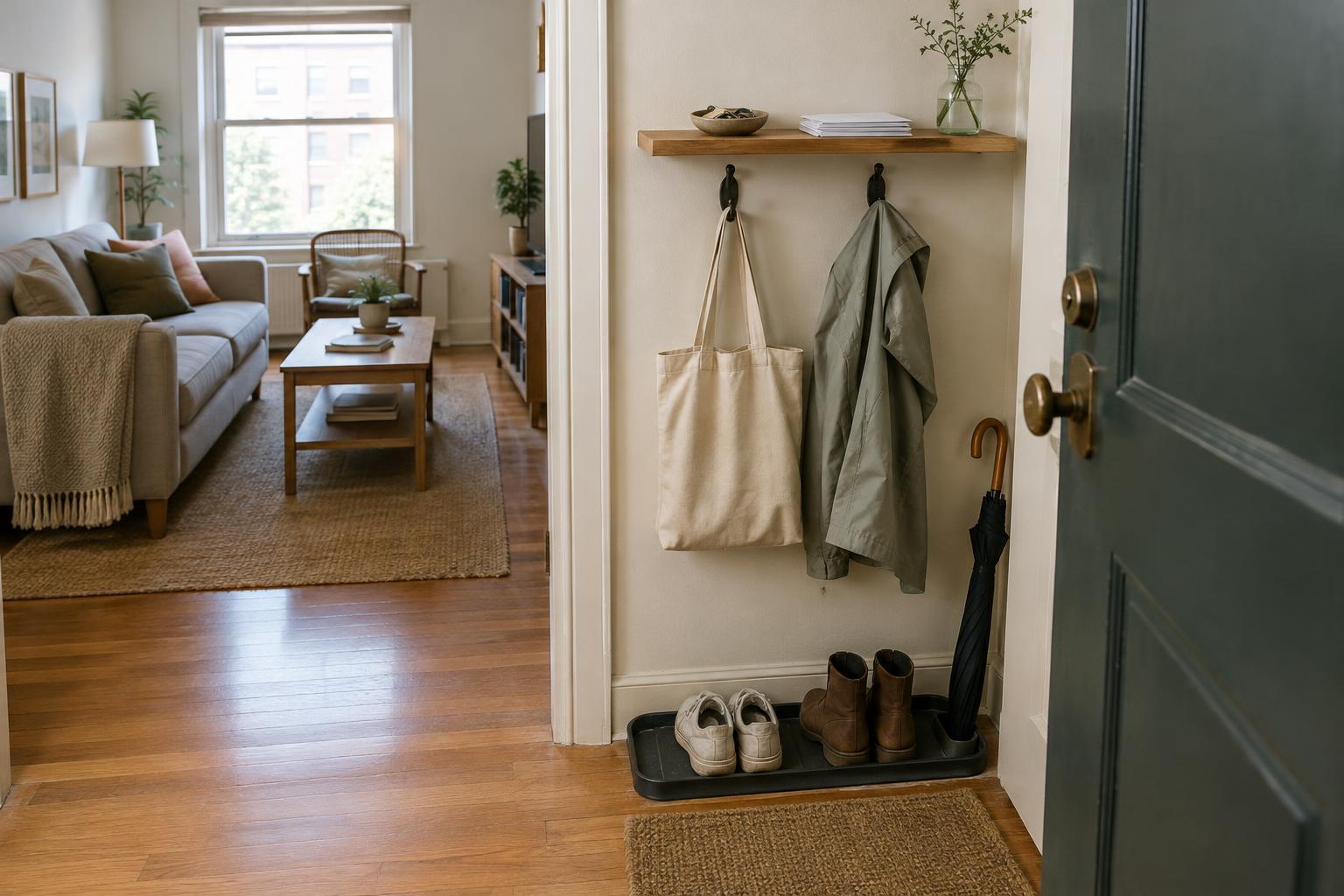
Start with the smallest pieces. A shallow dish on an existing shelf can hold keys and earbuds. A hook near the door can take a frequently used bag or jacket, provided it is securely installed and does not swing into the walkway. A narrow tray or boot mat can define a spot for one or two pairs of shoes. For mail, choose a single upright holder or folder rather than a broad surface where paper can spread.
Set a capacity that matches the space. If the shoe tray fits two pairs, move the extras to a closet or bedroom. If the hook is for your daily bag, avoid loading it with every tote you own. These limits make the drop zone easier to use and keep the rest of the room from becoming overflow storage.
Use the room you have, not the entryway you imagine
In a studio or small apartment, the edge of an existing piece of furniture may be enough. A small tray on a bookcase, the end of a kitchen counter or the top of a low cabinet can serve as the landing spot. Grouping items on a tray helps distinguish the drop zone from the surrounding living space, especially when there is no wall or doorway to mark the boundary.
If floor space is available, consider a slim console or a short bench with storage underneath. Measure the space with the door fully open, then check that you can pass while carrying groceries. A bench is only helpful if there is room to sit and stand comfortably; otherwise, a shoe tray may do more with less space.
Renters or anyone avoiding holes can try an over-door organizer, a freestanding rack or a removable option suited to the wall and the weight it must hold. Follow the product's installation guidance rather than assuming an adhesive hook can carry a heavy bag. The best setup is one that stays put during ordinary use.
Plan for rain, clutter and more than one person
A drop zone also has to handle the less tidy arrivals. Put a washable mat where damp shoes tend to land, and leave a place for a wet umbrella that will not drip onto paper or electronics. If a coat needs to dry, give it room to hang rather than packing it between other garments. Materials you can wipe or wash are often easier to live with near the door.
In a shared home, make destinations easy to tell apart. Separate hooks, labeled baskets or different sections of a shelf can prevent one person's essentials from burying another's. Keep shared items, such as spare keys or a reusable shopping bag, in one agreed-upon spot.
Do not make the system so complete that it consumes the room. Seasonal accessories, deliveries and seldom-used shoes can live elsewhere. The entry area works best as a short stop for items in active use, not as permanent storage for everything that might someday go outside.
Make the reset part of leaving or arriving
A compact drop zone needs a simple reset. Take outgoing mail or returns with you when you leave, move processed paper out of the holder, and return stray shoes to their usual storage. This can take less effort than repeatedly searching for a missing key or clearing a chair before you can sit down.
After living with the setup for a week or two, change what is not working. If keys still end up on the counter, put their dish there or closer to it. If bags collect on the floor, the hook may be inconvenient or already full. Let those small habits guide the arrangement. The right drop zone is not the one that looks most like an entryway; it is the one you can use without thinking.