Start with the jobs you actually do
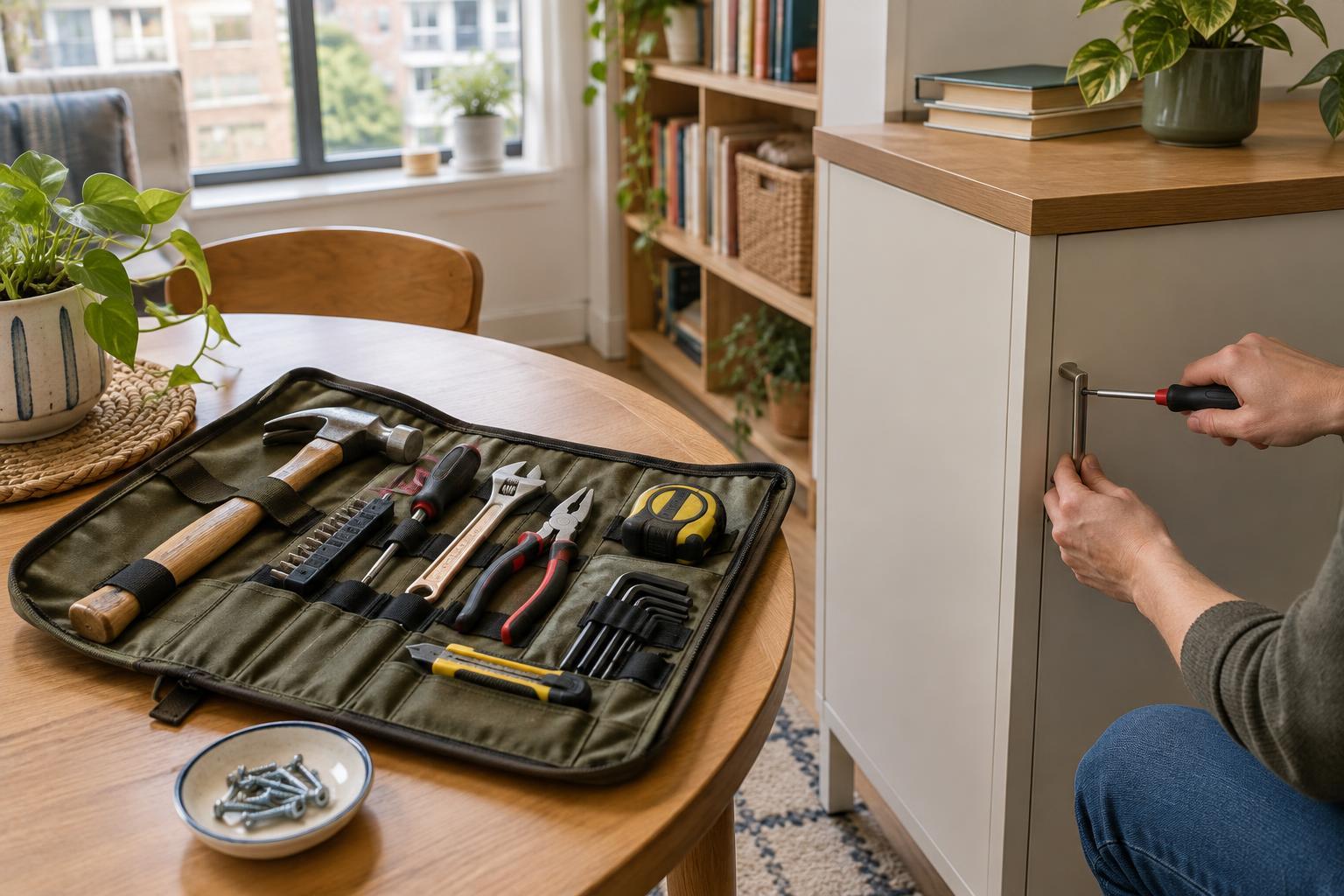
An apartment tool kit does not need to look like a contractor’s toolbox. Its purpose is to help with ordinary tasks: assembling a chair, tightening a loose cabinet handle, measuring a shelf space or replacing a worn felt pad. Start by thinking about the tasks you encounter in your home, then buy tools to match. This keeps the kit small and makes it more likely that you will know how to use everything in it.
Before buying anything, check what came with your furniture and what your building allows residents to do. Some flat-pack items include the hex key needed for assembly, while some rentals have rules about holes, wall fixtures and repairs. Keeping those instructions and spare fasteners in a labeled bag can be as useful as adding another tool.
Build a small core kit
A tape measure is a good first purchase. Use it to check furniture dimensions, doorway clearances and the space between a window and a wall. A retractable model that you can hold comfortably is usually enough for an apartment. Add a multi-bit screwdriver with common flat and cross-head bits, plus a small set of hex keys for furniture bolts. Choose bits that fit fasteners snugly; a poor fit can strip a screw head.
A compact hammer helps with light assembly tasks, while a small level helps you check whether a shelf or picture is straight. Adjustable pliers can grip or turn small parts, and an adjustable wrench is handy for nuts and bolts. These tools are useful without taking much room, but they are not interchangeable: use the tool that fits the part rather than forcing it. A flashlight or headlamp rounds out the kit for looking behind furniture and into dim cabinets.
Add cutting and finishing tools selectively
Scissors will cover many household jobs. If you regularly open packages, trim shelf liner or cut other suitable materials, a utility knife may be worthwhile. Choose one with a blade that retracts or folds securely, cut away from your body and protect the surface underneath. Store spare blades in a closed container, not loose in a drawer. Replace a dull blade rather than pressing harder.
A few consumables can make the kit more useful: painter’s tape for temporary marks, a pencil for measurements, and a small assortment of picture-hanging supplies suited to your walls and rental rules. Felt pads for furniture feet can help prevent scuffs. There is little reason to stock a large assortment of screws and anchors before you know what you need; hardware should be chosen for the specific item and surface.
Make careful work the default
Small jobs go more smoothly when you prepare first. Clear a stable work area, read the assembly instructions and lay out the parts before tightening anything. Measure twice when placement matters. Start screws by hand where possible, and stop if a fastener resists or the tool slips. For furniture, tightening every bolt fully at the start can make later pieces difficult to align; follow the assembly sequence instead.
Know where the boundary of a basic tool kit lies. Cutting into a wall, changing electrical wiring, working on plumbing or mounting a heavy item can involve hidden hazards or building-specific requirements. If you are unsure what is behind a surface, what a fixture can support or whether a repair is permitted, pause and ask your landlord, building manager or an appropriate professional. Use eye protection when a task could send dust or small pieces toward your face.
Store the kit so it stays useful
In a compact home, easy storage matters more than a large case. A small handled box, zippered pouch or divided drawer can hold the core tools together. Keep sharp items covered, contain loose bits in a small organizer and put the kit somewhere you can reach without moving a pile of other belongings. If children can access the space, use storage that keeps sharp tools and small parts out of their reach.
After a job, wipe off dust, return bits to their holders and note anything missing or damaged. Keep furniture instructions and leftover parts in one labeled envelope or bag. Over time, you may find that a particular task justifies another tool. Until then, a modest kit that you can find, carry and use confidently is better than a crowded collection bought for jobs you may never do.