Start with the space, not the container
A good organizer makes an item easier to find, take out, and put away. Before buying anything, look at the space where the clutter collects. Is it a deep shelf that hides small objects, an open surface you see every day, or a drawer where things slide into one another? That question will usually point toward a bin, basket, or divider.
Next, consider how often you use the contents. Daily essentials need a quick, low-effort home. Items you reach for occasionally can go in a covered or stackable container. Measure the available width, depth, and height, including the clearance needed to pull a container out. A perfect-looking box is not useful if it catches on a shelf or forces you to unpack three other boxes first.
Choose bins for contained groups and deeper storage
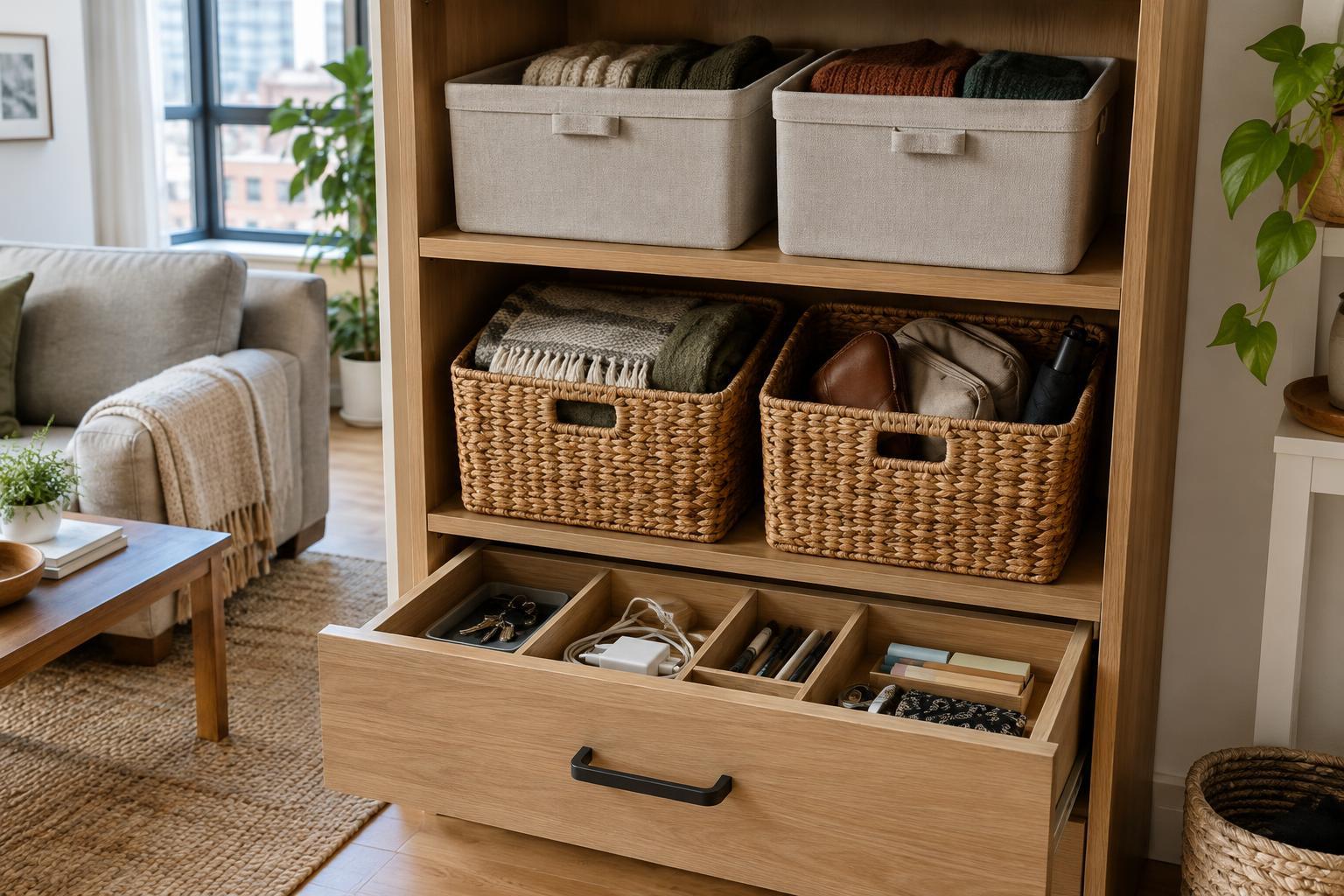
Bins work well when several related items need to move as one unit. On a deep closet shelf, a bin can bring spare toiletries or cleaning supplies forward without making you reach behind other objects. In a cabinet, separate bins can give lightbulbs, batteries, and small household supplies distinct homes. Solid sides also help keep loose items from tipping or spilling onto the shelf.
Match the bin to its location. A clear bin makes contents visible when you have several similar containers; an opaque one can make an open shelf look calmer. Handles help with high or deep shelves, provided the loaded bin is comfortable to lift. Lids can protect seldom-used contents from dust, but they add a step to every retrieval. Avoid using a large bin as a catchall: it may hide clutter rather than organize it. Smaller categories, simple labels, and a little empty space make bins easier to maintain.
Use baskets where easy access matters
Baskets are especially useful in visible, frequently used spots. An open basket by the door can hold scarves or reusable bags; one on a living-room shelf can gather remote controls and charging cables. The contents are easy to drop in, which makes a basket a practical choice for things that tend to land on a table or chair.
Open tops are convenient, but they also let dust settle and make overfilling noticeable. Woven baskets may snag delicate fabric or allow tiny items to slip through gaps; a smooth-sided basket is often better for those contents. In a bathroom or near a sink, choose a material that suits the moisture level and can be cleaned easily. Give each basket a clear purpose. If it regularly fills with unrelated objects, sort what is inside before adding another basket.
Put dividers inside drawers with mixed contents
Drawer dividers solve a different problem: they keep small items separate within a space that already has walls. They are useful for socks, kitchen tools, desk supplies, and other objects that become difficult to find when they shift together. Unlike a basket or bin, a divider lets you see several categories at once when you open the drawer.
Choose compartments around what you own rather than forcing items into a preset layout. Adjustable dividers can help in an unusually sized drawer, while small removable trays let you lift out one group at a time. Check the drawer’s interior height as well as its width and depth, and leave enough room for it to close without crushing the contents. Dividers are most effective after you remove duplicates and items that belong elsewhere; they cannot make an overstuffed drawer easy to use.
Combine tools only when each has a job
You do not have to choose one organizer for an entire room. A compact entryway might use a basket for grab-and-go accessories, a bin on an upper shelf for off-season items, and a divider in a drawer for keys, transit cards, and other small essentials. The choice depends less on the room than on whether items need to be grouped, displayed for easy access, or kept apart.
Try arranging the space with containers you already have before committing to a matching set. Use the setup for a week or two and notice where objects actually land. If putting something away feels awkward, its home may be too far away, too full, or too difficult to open. The best system is one you can reset in a few minutes, not one that only looks tidy immediately after you arrange it.