Start with the space you actually have
A shared closet or cabinet can feel full even when it holds relatively little. The trouble is often that items overlap: one person’s sweater ends up behind another person’s bag, or a shared supply disappears among personal products. Before buying organizers, take everything out of one storage area and group it by owner and use. Separate personal belongings from things everyone reaches for, and set aside anything that belongs elsewhere.
Then look at the usable space rather than dividing it by appearance alone. A high shelf may offer plenty of room but be inconvenient for something used every morning. Deep cabinet corners are better suited to less-used items than daily essentials. If one person needs more hanging space and another needs more shelves, equal access may matter more than identical allocations. Agree on a layout that both people can use without moving each other’s things.
Give personal and shared items distinct homes
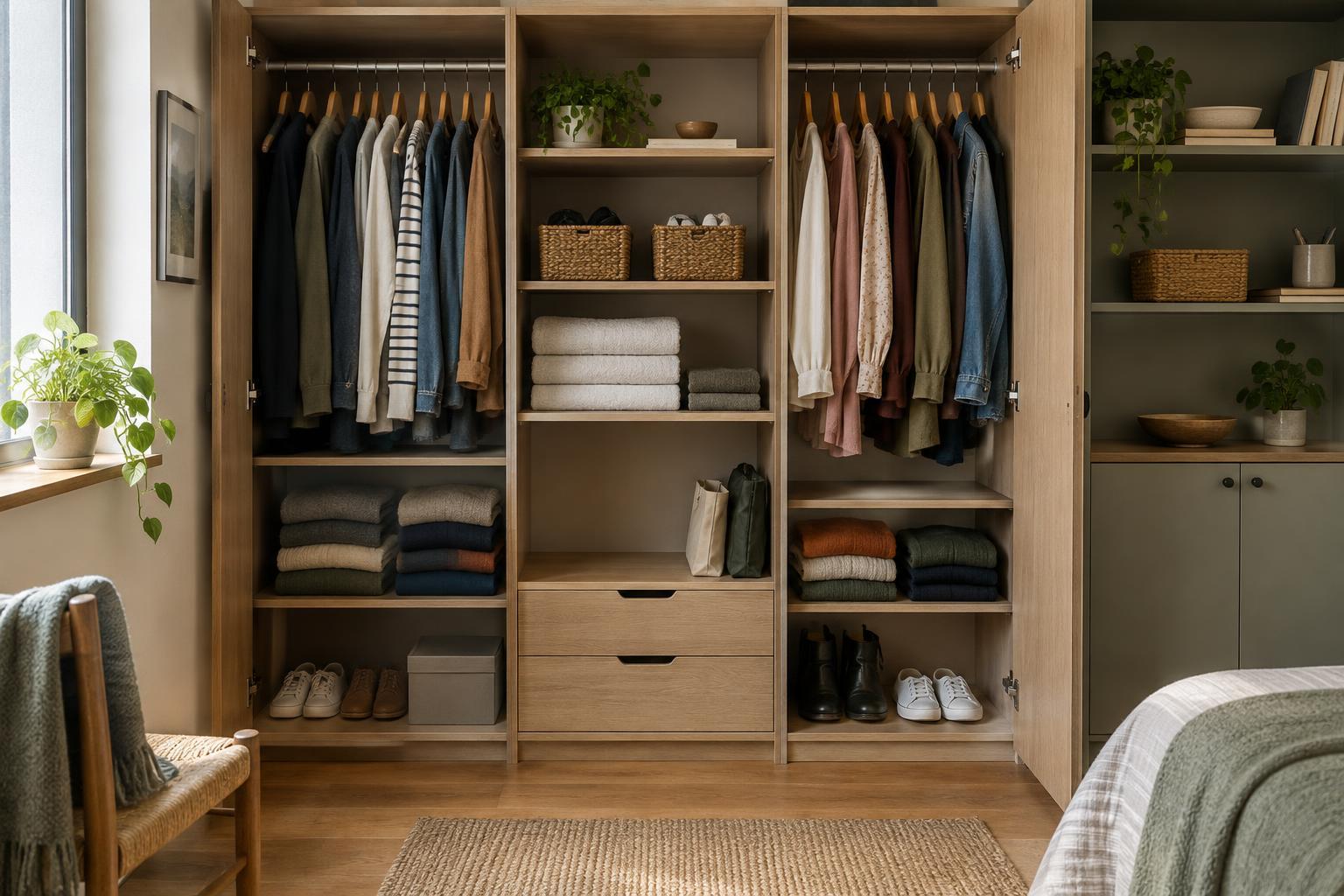
Assign each person a zone with visible boundaries: a shelf, a stretch of hanging rail, a drawer or a bin. Try to keep each person’s everyday items together instead of scattering them across the closet. In cabinets, place shared supplies in a separate zone so no one has to search through someone else’s belongings. Simple labels can help when shelves are crowded or several containers look alike.
Leave a little open space between zones if possible. It makes it easier to put things away and notice when belongings have crossed a boundary. For items that genuinely move around, such as a borrowed umbrella or a frequently used tool, choose one return spot. A designated home is easier to remember than a rule that depends on who used the item last.
Make everyday items easy to find and return
Put frequently used belongings at comfortable reach and occasional items higher, lower or farther back. Within each zone, arrange things so the contents remain visible. A row of folded clothes, a shallow tray for small accessories or a bin that pulls out of a deep shelf can make it easier to see what is there. Containers are useful when they solve a specific problem; too many can hide items just as effectively as a crowded shelf.
Use labels to name broad categories rather than every individual object. “Cold-weather accessories” is likely to stay useful longer than a detailed list that needs updating each time a pair of gloves moves. For closed bins, a short label on the front saves repeated opening. If you share a bathroom or kitchen cabinet, keep products with similar purposes together and place anything that needs special care according to its own storage instructions.
Create a plan for overflow and temporary items
Even a good layout can fail when new things arrive without a place to go. Decide where an incoming purchase or an item waiting to be repaired will sit temporarily. A small, clearly defined holding spot prevents these objects from spreading across shelves. When that spot fills, sort it before adding another container or taking space from someone else’s zone.
Seasonal items can rotate into harder-to-reach storage, but keep the process simple. Group them by person or purpose and label the outside of the container. Avoid packing a closet so tightly that retrieving one item requires emptying an entire shelf. If the shared space cannot hold everything, it is more useful to acknowledge that limit together than to keep rearranging the same crowded cabinet.
Agree on a reset routine that fits real life
A shared system needs a way to recover from busy days. Agree on a few straightforward habits, such as returning borrowed items to their assigned spot and checking before moving another person’s belongings. A brief reset when you put laundry away or restock supplies can catch misplaced items before they become hard to find.
Revisit the layout when routines change. A shelf that worked for winter layers may be better used for something else later, and a shared category may outgrow its container. If an item repeatedly lands in the wrong place, that may be a sign that its assigned home is inconvenient. Adjust the system rather than relying on everyone to remember a rule that does not match how they use the space.