Start with the places you will use it
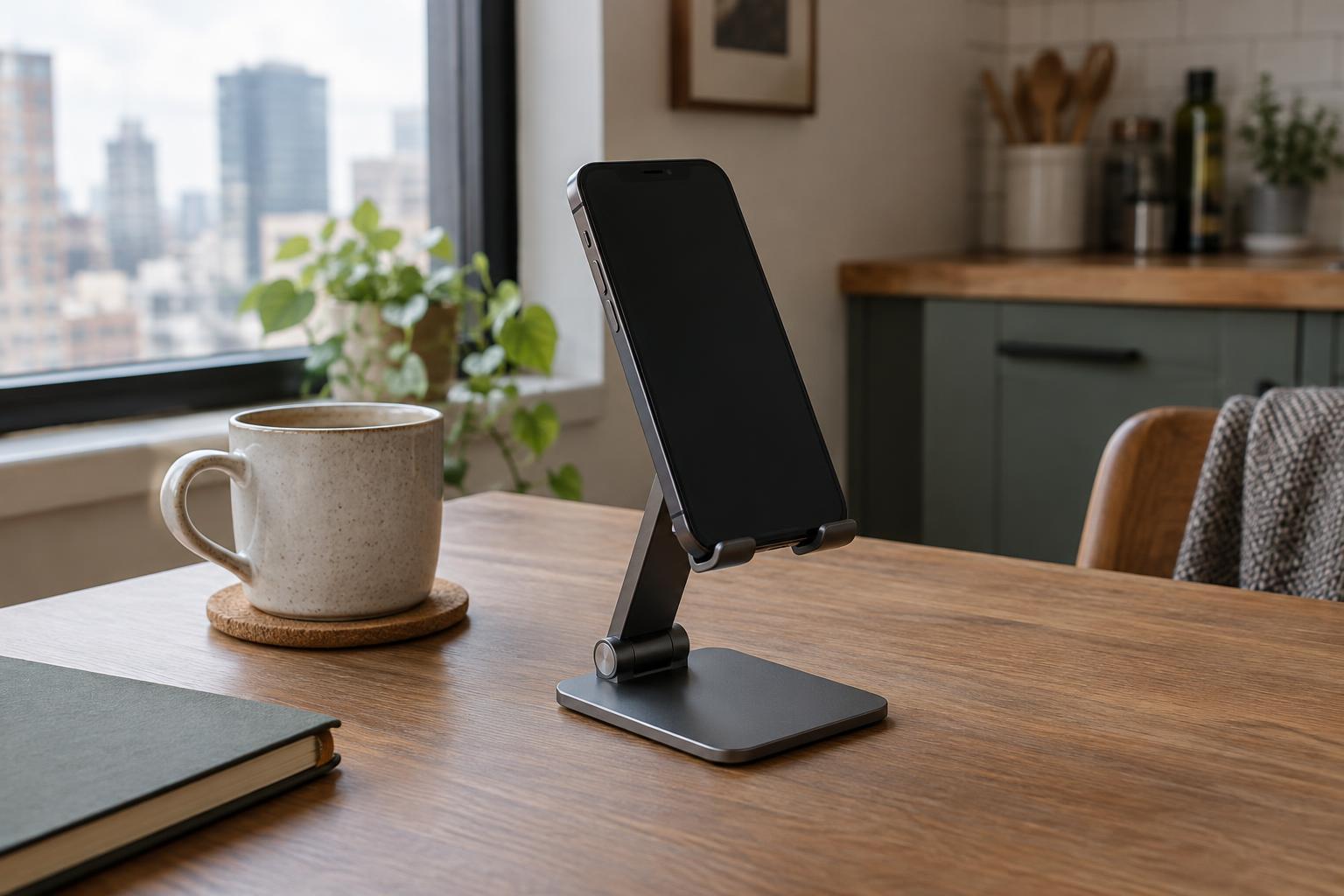
A portable phone stand is most useful when it solves a specific annoyance. Perhaps your phone slides across the desk during a video call, takes up counter space while you follow a recipe, or needs to sit upright while you eat lunch. List the two or three places you would actually set it down. A stand that works well on a firm desk may be awkward on a narrow kitchen shelf or a crowded café table.
Think about whether the stand will stay at home or travel in a bag. For a fixed spot, a wider base may be worth the space it occupies. If you carry it daily, check its folded shape as well as its weight. A flat stand with no protruding parts is often easier to slip beside a notebook than one that folds into a bulky block.
Check stability before extra features
A stand should hold your phone steady when you tap the screen, not just when you leave it untouched. Look for a base that sits flat, a hinge that stays in position, and a ledge deep enough to support the bottom edge of your phone. Pads on the base and contact points can help reduce slipping and protect surfaces, but they cannot compensate for a narrow base on an uneven table.
Consider how you normally position your phone. A heavier phone or a thick case may shift the balance backward, especially when the viewing arm is raised high. If you can try a stand before buying it, place your phone in its case on the stand, adjust it to your preferred angle, and tap near the top of the screen. If you cannot try it, favor a design with a broad footprint and a straightforward support mechanism over one that depends on a tiny hinge.
Choose an angle that fits the task
Adjustability is helpful, but more moving parts are not automatically better. For video calls at a desk, you may want the screen closer to eye level to avoid hunching. For recipes, a lower angle can make the screen easier to glance at from above. If you switch between these tasks, look for a stand that lets you change both height and tilt without a complicated setup.
Check whether the stand works in portrait and landscape orientation. Landscape can be convenient for watching a lesson or following a demonstration, while portrait may suit calls, messages, and lists. Make sure the support ledge does not cover a part of the screen you regularly need to touch. If you charge your phone while it is propped up, leave room for the charging cable to connect without a sharp bend.
Pay attention to fit and everyday handling
The best fit depends on the phone you actually carry, including its case. A raised lip, card pocket, or strap on the case can change how securely it sits against a stand. Check the width of the stand’s ledge and where its back support meets the phone. A stand that grips too tightly may be inconvenient if you pick up your phone often; one with little support may shift whenever you touch it.
Also consider how easily you can open, adjust, and clean the stand. A simple folding design can be useful when you have only a minute to set up at a shared table. In a kitchen, wipeable surfaces and few narrow crevices make it easier to deal with splashes. Keep the stand away from heat, sinks, and the edge of the counter, and move your phone with clean, dry hands when possible.
Make a short list instead of chasing a perfect stand
Before choosing, rank your priorities: stable tapping, adjustable height, small folded size, easy cleaning, or a low profile on the desk. These qualities can pull in different directions. A very compact stand may have a smaller base, while a taller stand may need more room to remain steady. Decide which trade-off matters least for your routine rather than looking for every feature in one accessory.
Once you have a stand, give it a consistent place to live. Keep a home stand near the surface where you use it most, or assign a small pocket in your bag to a travel stand. If you repeatedly forget it or find it awkward to unfold, that is useful feedback: the simplest stand that fits your space and habits may be the one you actually use.