Start with a baseline you can learn from
Before trying to type faster, find out what happens when you type at a comfortable pace. Choose a short passage you have not memorized and copy it for a few minutes. Keep your eyes mostly on the text and screen rather than watching every key. When you finish, compare your version with the original. A speed score can be interesting, but the most useful result is a small list of errors you can recognize.
Look for patterns instead of treating every typo as a separate problem. Do you swap the order of letters, miss spaces, reach for the wrong keys, or forget capital letters and punctuation? Notice whether errors appear throughout the passage or mainly when you hurry. Keep this first attempt as a reference, not a verdict on your ability. A later practice session is easier to evaluate when you know what you were trying to improve.
Make your setup easy to repeat
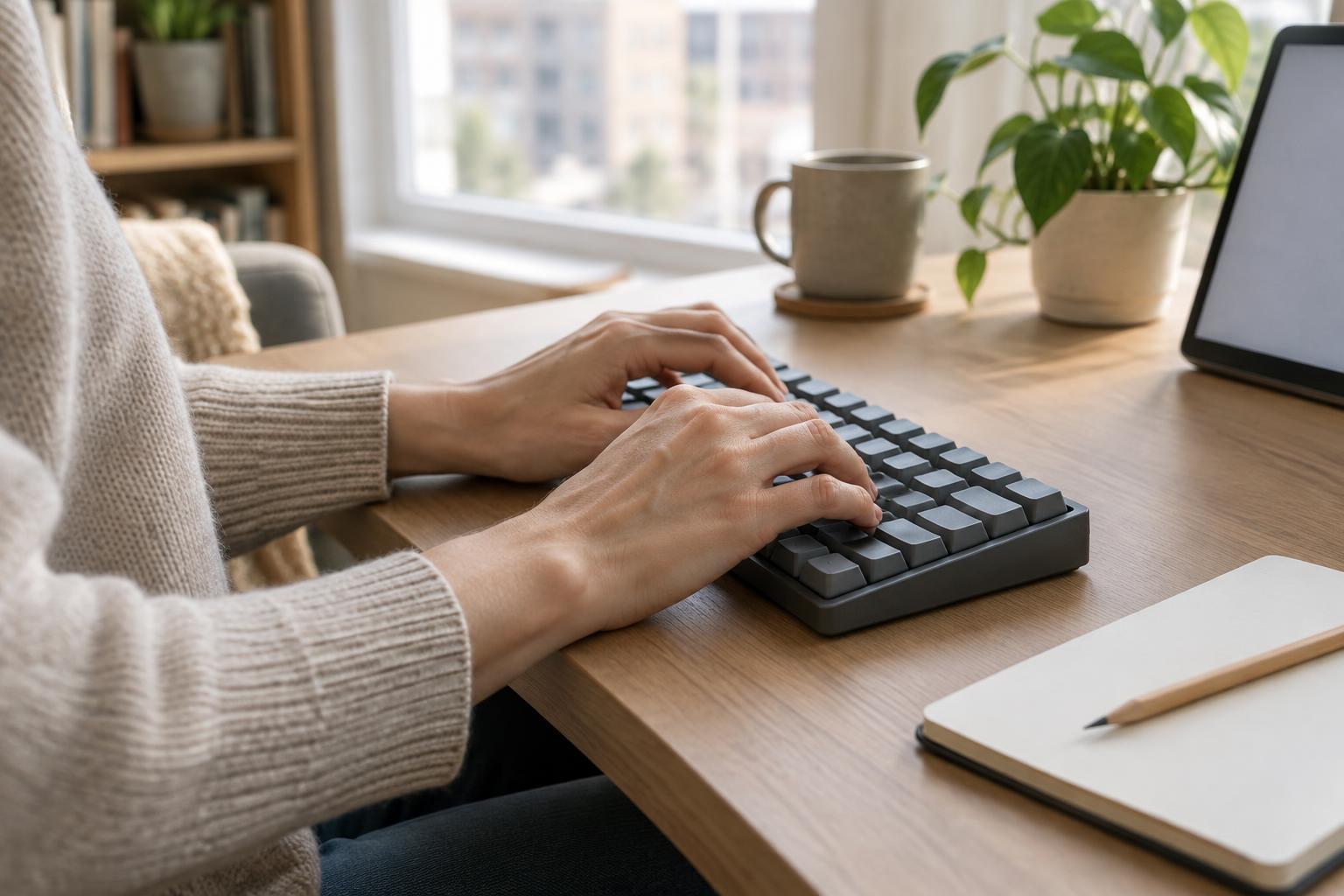
Accuracy practice works best when your hands can approach the keyboard in a consistent way. Place the keyboard where you can use it without stretching toward it, and settle into a position that feels comfortable rather than forcing a rigid pose. If you switch between a laptop keyboard and an external one, expect each to feel different. Practice on the keyboard you use most often, or allow a little time to adjust when you change devices.
Try to begin each session with your fingers near familiar starting keys. From there, let each finger make a small, deliberate movement and return to a place you recognize. You do not need to master every key at once. Concentrate first on common letters, spaces and punctuation you use in ordinary messages. Consistency matters more than a perfect-looking technique: the aim is to make the next key easier to find without stopping to search for it.
Slow down enough to type deliberately
During an accuracy session, choose a pace at which you can anticipate the next few characters. If your hands frequently get ahead of your attention, slow down. This may feel less productive than racing through a passage, but repeated, correct movements give you something reliable to build on. Type words as groups of letters rather than pausing to inspect each individual keystroke, while staying slow enough to notice when a sequence feels uncertain.
Short practice blocks are easier to focus on than a long session spent fighting fatigue or distraction. You might copy one paragraph, review it, and then copy another with a single goal in mind, such as clean spacing. Use material that resembles what you actually type: emails, notes, instructions or code all place different demands on your hands. Familiar subject matter is fine, but vary the wording so you are practicing typing rather than recalling a memorized passage.
Turn mistakes into small practice targets
After each passage, pick one recurring error to work on. If you often transpose two letters, type the troublesome word or letter pair slowly several times, then use it in a few different sentences. If punctuation causes problems, practice sentences that include the marks you need. Isolating a difficulty helps, but return to normal text afterward; a key that feels easy in a drill may still be awkward in a sentence.
Decide in advance how you will handle errors while practicing. In one exercise, you can correct each mistake immediately to reinforce the intended word. In another, you can finish the passage and review it afterward to see which mistakes appear when you keep moving. Both approaches are useful if you know what you are measuring. Avoid repeatedly backspacing in frustration without noticing what went wrong. A brief note such as “missed spaces after punctuation” gives the next session a clear purpose.
Add speed only when accuracy holds
Once you can type a short passage cleanly at a relaxed pace, increase your pace a little while keeping the same attention to the text. If errors multiply, return to the previous pace and practice there before trying again. Progress does not have to mean a faster score every day. It can also mean needing fewer corrections in an email or staying accurate through a longer paragraph.
Make typing practice easy to fit into your routine: a few focused minutes before a writing task can be enough to revisit one skill. Occasionally repeat a passage of similar length and difficulty to your baseline, then compare both the number and kinds of mistakes. When accuracy feels steady, speed becomes a reasonable next goal. You will have a dependable technique to accelerate rather than a habit of rushing and repairing.